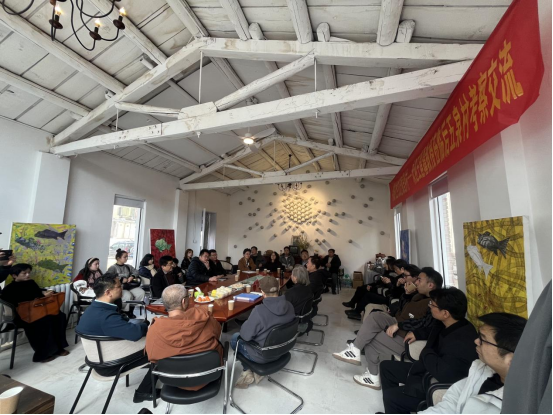
The Art Rural Revitalization Tourism Association, in collaboration with the Houwuquan Village Committee, invited Professor Wang Jianzhang to hold a lecture and exchange event on the theme of “Bie-Modernist Cultural Computing Enhancing Rural Beauty”.
On the afternoon of March 1st, a special lecture titled “Bie-Modernist cultural Computing is used to model the art-based rural revitalization and tourism and cultural industry” was held at the Taiqueli Art Center of the Houwu+HOME Art Park in Houwu Village, Baxi Town, Lanzhou City, jointly organized by the Art Rural Construction Tourism Branch of the Gansu Tourism Association and the Village Committee of Houwu Village, Baxi Town, Lanzhou City. The event was holded by the Lanzhou Beef Noodle Culture Town, the Houwu+HOME Art Park,the Lanzhou Art-Bang Fine Arts Education, and the Gansu Guancheng Planning and Design Research Co., Ltd. The lecture was delivered by Professor Wang Jianzhang, a professor and doctoral supervisor at Shanghai Normal University, the director of the Institute of Aesthetics and Art Education, and the founder of the theory of Bie-modernism. Representatives from township management departments, academia, planning and design circles, art education and training sectors, the field of artificial intelligence, tourism and cultural enterprises, and villagers gathered together to jointly explore innovative paths for enabling rural revitalization through cutting-edge theories.
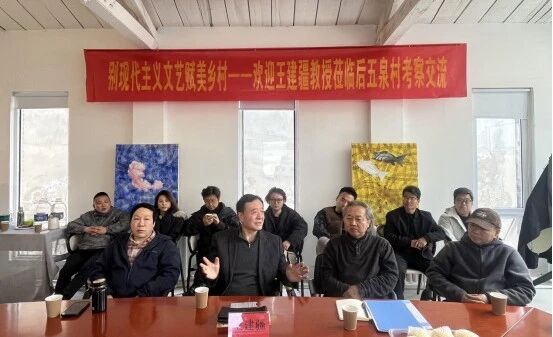
Professor Wang Jianjiang systematically expounded the core connotation of the “Bie- Modernism” theory in his lecture. For the first time, he combined it with the emerging interdisciplinary field of “Cultural Computing”, proposing the idea of constructing a digital model for art-based rural revitalization and the cultural tourism industry. He pointed out that “Bie-Modernism” emphasizes the analysis and transcendence of the mixed state of “true modern”, “false modern” and “pre-modern”, while “Cultural Computing” uses technological means such as big data and artificial intelligence to conduct quantitative analysis and modeling of cultural resources. The integration of the two can provide scientific basis and innovative models for the exploration of rural cultural resources, the design of paths for art to intervene in rural construction, and the precise development of cultural tourism products.